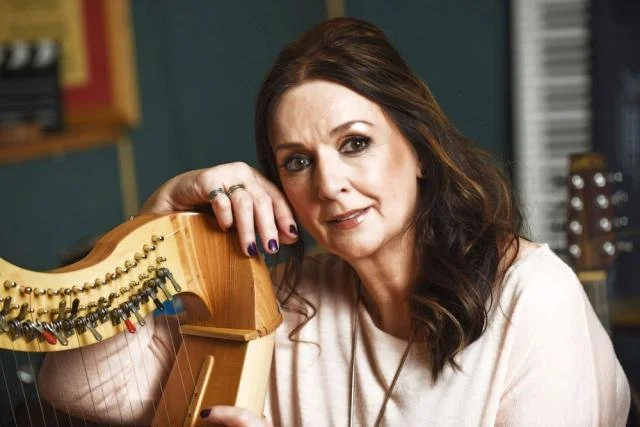
A personal tribute to Moya Brennan — through the eyes of a harp teacher
Diffusé dans la Newsletter - Juin 2026
Máire Philomena Ní Bhraonáin -1952/2026-
In recent days, I’ve been thinking a lot about Moya Brennan.
Like many of us in the Celtic music world, I discovered her first as a voice…
but over time, I came to understand something deeper: her relationship with the harp.
As a harp teacher, I often see students searching for “how to play beautifully.
And beyond technique, beyond speed, beyond complexity… I believe Moya Brennan carried one of the most important answers.
The harp as a breath, not a performance
With Clannad, the harp is rarely about demonstration.
It doesn’t try to impress — it supports, it breathes, it listens.
And this is something I try to pass on to my students:
the harp is not only an instrument to “play”… it is an instrument to inhabit.
When I listen to Moya Brennan, I don’t hear someone trying to fill space. I hear someone who allows silence, resonance, and fragility to exist. That is a lesson in itself.
What she quietly teaches us as harpists
You don’t need to play many notes to say something meaningful
Some of her most touching moments are built on simplicity. As teachers, we sometimes need to remind students that depth does not come from complexity.The connection between voice and harp is essential
Even if you don’t sing, phrasing on the harp can be vocal. Breathing, shaping, letting notes live — she embodied that beautifully.Resonance is part of the music
In a world where everything moves fast, she reminds us to let the sound ring… and to trust it.Sensitivity is not weakness
Her playing was never about power — yet it carried immense emotional strength. That is something many harpists need to hear.
The Pieces I Keep Coming Back To
When I listen to Clannad again, certain pieces return like familiar landmarks:
• “Theme from Harry’s Game” — for its purity and silence, and because this piece became Clannad’s signature song
• “In a Lifetime” — for its emotional dialogue and its unique connection with Bono
• “Newgrange” — for its almost ancestral grounding
• “Robin (The Hooded Man)” — for its mystery and evocative power
These are not just songs — they are places we return to.
What I will continue to pass on, thanks to the lesson that Moya Brennan shared with us.
If there is one thing I would pass on from Moya Brennan’s legacy, it is this: We are not here only to play the harp well.
We are here to listen, to feel, and to dare to be simple.
In my own teaching, I see how powerful this can be.
A student who slows down… who listens to a single note… who allows emotion to come through… is already making music.
And in that sense, Moya Brennan will continue to teach —through every harpist who chooses sincerity over performance.
Youtube Link
🎶 Moya Brennan funeral Enya rare appearance and Bono emotional farewell
🎶 Moya Brennan at Shrewsbury Folk Festival 2023
Eve McTelenn - (c) Avril 2026 - Newsletter