Great Figure of Classical and Breton Harp Has Passed Away
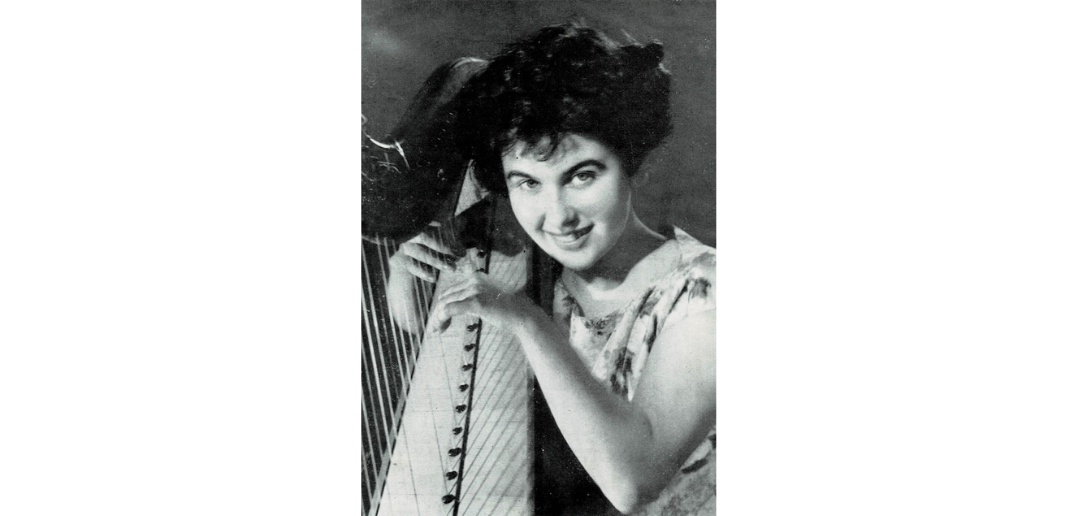
Madeleine Buffandeau-Maingourd - 1937-2026
Photo : famille Buffandeau-Maingourd
Writing about Marie-Madeleine Buffandeau-Maingourd required careful cross-checking: newspaper articles, online archives, testimonies from Alan Stivell, words from Mariannig Larc'hantec — who was one of her students — as well as exchanges with her former husband, Philippe Maingourd.
Through these intersecting voices, a life gradually takes shape — and with it, an entire chapter of the revival of the Celtic harp in France. A subject that deeply fascinates me, and to which I will soon dedicate further articles.
A Great Figure of Classical and Breton Harp Has Passed Away
Harpist and musicologist Marie-Madeleine Buffandeau-Maingourd, also known by her Breton name “Madalen,” passed away on January 8, 2026, at the age of 89.
A tribute was held on Wednesday, January 14, at 2:30 p.m., in the church of Ploufragan, near Saint-Brieuc, where she had lived for three decades before retiring there.
With her passing, an important page in the history of the harp in France — at the crossroads of classical tradition and Celtic revival — turns.

TELENN BLEIMOR / groupe de harpeurs* 1954 1962 au Congrès Interceltique de Tréguier De g. à droite : Rozenn Guilcher, Brigitte Baronnet, Madalen Buffandeau, Armel Le Sech
Crédit Photo : Armel Le Sech
An Outstanding Education at the Paris Conservatory
In 1956, Madeleine Buffandeau was awarded a First Prize in harp as well as a First Prize in harp and chamber music at the Conservatoire national supérieur de musique de Paris.
The following year, the musical press praised a young performer already recognized for her virtuosity and sensitivity, on the occasion of a recital at the Salle Pleyel in Paris (source: ABP).
At that time, harp instruction in major French institutions focused primarily on the pedal harp within the great classical tradition. This distinguished training opened the doors to an international performing career.
Alongside her concert activity, she pursued work in musicology. A Breton cultural periodical reports that, as early as the 1960s, she defended a thesis at the Sorbonne on the renewal of popular music.
Two musicology theses on Breton modes are also mentioned as having been submitted at the Paris Conservatory in the class of musical aesthetics (source: Mariannig Larc'hantec ABP).
Her path unfolded both on stage and in academic research.
Telenn Bleimor:
A Pioneering Ensemble in Paris
In Brittany, Madeleine Buffandeau remains particularly associated with Telenn Bleimor, a major ensemble in the modern history of the Breton harp.
Several sources cite her as director or leader of the group, and as one of the first teachers to structure Celtic harp instruction within this movement.
Telenn Bleimor was founded in Paris by Perig Keraod, father of Armel Lesech, as part of the Breton cultural movement Bleimor. Created in the 1950s, the ensemble aimed to revive the Breton harp both instrumentally and pedagogically.
Telenn Bleimor is described as the first highly emblematic group of young women harpists who, from the 1950s onward, restored this instrument — resurfacing from the depths of Breton and Celtic history — to public attention. The instrument’s brilliant revival was later popularized in solo performance by Alan Stivell.
At a time when there was virtually no continuous tradition of Celtic harp playing in France, Telenn Bleimor functioned as a true laboratory:
rediscovery of repertoire,
structuring of pedagogy,
training of a new generation of harpists.
In 1963, Madeleine Buffandeau joined the harp section created for young Parisian women scouts within Telenn Bleimor. She trained many musicians, often from the Breton diaspora.
According to Ouest-France, she taught throughout nearly all of Brittany.
Philippe Maingourd stated that she “contributed to the revival of the Celtic harp.” He described her as “a great name in classical and Breton music in the 1960s and 70s and beyond.”
At the same time, another artist was participating in this revival: Alan Stivell. Madeleine Buffandeau’s name, however, remained more discreet, as she chose to pursue a career more strongly oriented toward classical musical training.
Georges Cochevelou
A Foundational Generation
In the early 1960s, Celtic harpists in France were extremely few. Teaching structures were embryonic, instruments were rare, and repertoire was still being reconstructed.
Madeleine Buffandeau’s generation belonged to those pioneers who:
built bridges between classical and Celtic harp,
contributed to giving musical legitimacy to the re-emerging Breton instrument,
established sustainable teaching structures.
Through teaching — lessons, mentorship, guidance of students — her influence spread. She helped form a generation of harpists and strengthened the instrument’s place within the Breton musical landscape.
At the first Celtic Harp Festival in Saint-Brieuc in 1981, organized by the city and directed by Soazig Noblet, an article mentions Madeleine Buffandeau as the teacher of Mariannig Larc’hantec.
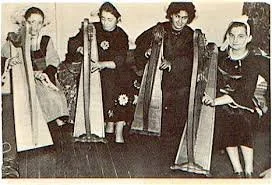
Crédit Photo : Armel Le Sech
Marianig Larhantec, Brigitte Baronnet va c'hoar, Madalen, Francoise Johannel.
A Living Legacy
Today, as the Celtic harp is widely taught in Brittany and beyond, and as festivals and educational programs flourish, it is essential to remember those who worked during the decades when everything still had to be built.
Madeleine Buffandeau leaves behind an important artistic, pedagogical, and musicological legacy.
The tribute that moved me most deeply was one harpist speaking of another. Mariannig Larc’hantec wrote (source: ABP):
“I would like to pay a deep, respectful, and of course affectionate tribute to the one who placed my hands on the harp, thus shaping my entire professional path. We also owe her two musicology theses on Breton modes, which she submitted at the Paris Conservatory in the class of musical aesthetics.”
Through these words, the depth of transmission becomes clear.
The revival of the Celtic harp did not rely solely on a few highly visible figures. It was also built by teachers, researchers, and transmitters of knowledge.
And this is the story I will continue to explore.
Interesting resources to read and discover for your cultural enrichment (in french)
Le premier petit mag sur la harpe celtique - Hiver 1985
Une ancienne de la Telenn Bleimor qui raconte sa propre histoire dans le groupe de la Telenn Bleimor
Magazine - Musique Bretonne - 1981
Le 1er festival de harpe celtique à St Brieuc, organisé par la ville et ayant comme directrice Soazig Noblet, on mentionne dans l’article, le nom de Madeleine Buffandeau comme le professseur de Mariannig larcantec